Unit circle chart
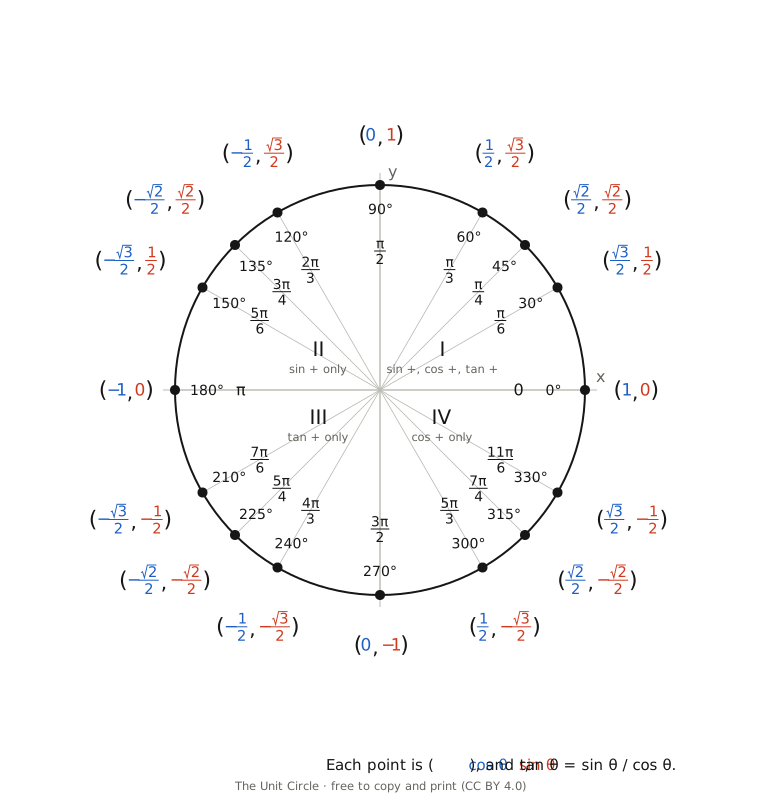
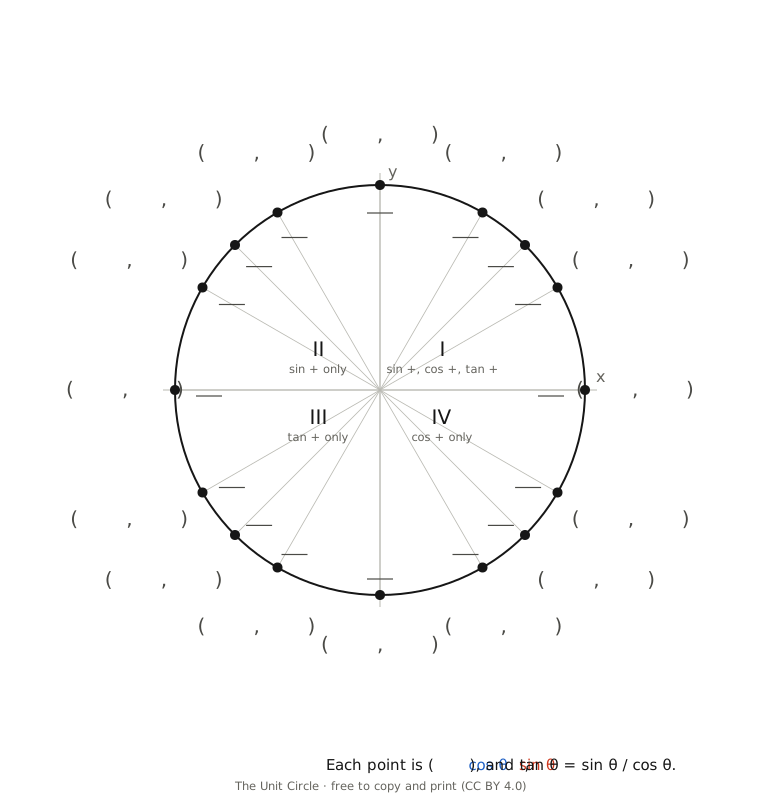
Every special angle in degrees and radians, with the exact coordinates (cos θ, sin θ) of its point. Print it, or print the blank one and fill it in.
| Degrees | Radians | cos θ | sin θ | tan θ |
|---|---|---|---|---|
| 0° | 0 | 1 | 0 | 0 |
| 30° | π6 | √32 | 12 | √33 |
| 45° | π4 | √22 | √22 | 1 |
| 60° | π3 | 12 | √32 | √3 |
| 90° | π2 | 0 | 1 | undefined |
| 120° | 2π3 | −12 | √32 | −√3 |
| 135° | 3π4 | −√22 | √22 | −1 |
| 150° | 5π6 | −√32 | 12 | −√33 |
| 180° | π | −1 | 0 | 0 |
| 210° | 7π6 | −√32 | −12 | √33 |
| 225° | 5π4 | −√22 | −√22 | 1 |
| 240° | 4π3 | −12 | −√32 | √3 |
| 270° | 3π2 | 0 | −1 | undefined |
| 300° | 5π3 | 12 | −√32 | −√3 |
| 315° | 7π4 | √22 | −√22 | −1 |
| 330° | 11π6 | √32 | −12 | −√33 |
The table gives the sixteen special angles of the unit circle, the multiples of 30° and 45°, with exact values of cos θ, sin θ and tan θ. The chart shows the same angles in degrees (inside the rim) and radians (further in), with the exact coordinates of each point outside the circle. The first coordinate, in blue, is cos θ; the second, in vermilion, is sin θ. Tangent is their ratio. For any other angle, use the trig calculator.
Download the chart (SVG) Download the blank circle (SVG)
How to read it, and how not to need it§
Everything on the chart comes from three facts, explained with moving figures in Chapter 1. At 30°, the point and its mirror image make an equilateral triangle with the center, so sin 30° = 1/2 and cos 30° = √3/2. At 45° the two coordinates are equal, so each is √2/2. At 60° the 30° values swap. Every other point is a reflection of one of those, with signs set by the quadrant: cosine is negative left of the y-axis, sine is negative below the x-axis.
To convert an angle from degrees to radians, multiply by π/180: 150° × π/180 = 5π/6. The radians chapter explains why a full turn is 2π.
The chart is generated from the same table of exact values that the site’s interactive figures use, and that table is checked against computed sines and cosines to fifteen decimal places, so the chart and the figures cannot disagree.
The unit circle with tangent§
The printed chart leaves tangent out to stay readable, because tan θ is the ratio of the two numbers already there: sin θ / cos θ. The table at the top of the page gives it in full for all sixteen angles. Two of them have no tangent at all. At 90° and 270° the cosine is 0, and on the circle the reason is visible: the radius extended through the point runs parallel to the tangent line x = 1 and never meets it.
On the circle, tan θ is a length too: the height at which the extended radius meets the vertical line x = 1, which touches the circle at (1, 0). That is where the name comes from (a tangent line), and it is drawn as the yellow bar below. Three facts make the tangent column easy to rebuild from memory: tan 45° = 1, because the two coordinates are equal there; tan 30° = (1/2)/(√3/2) = 1/√3 = √3/3; and tan 60° = √3, its reciprocal. The signs follow the quadrants: tangent is positive where sine and cosine agree in sign (quadrants I and III) and negative where they differ.
The tangent and the other three functions (secant, cosecant and cotangent) are drawn together as lengths on one circle in Chapter 1.
Blank unit circle for practice§
The blank version has the sixteen points marked and nothing else. Fill in the degrees, radians and coordinates from the three facts above, then check against the full chart. There is an interactive version with feedback in Chapter 1.